
Property values are not determined by location, floor area and technical building quality alone. What also matters is how convincingly a property functions in everyday use. For private and institutional investors, owners and asset managers, the quality of the interior is therefore becoming an important component of a long-term property strategy. Well-considered interior design does more than enhance aesthetic perception. It can significantly influence the usability, positioning and long-term appeal of a property.
Interior Design as Part of the Property Strategy
During a renovation, interior design is often only considered once floor plans, technical planning and budgets have already been largely defined. This leaves valuable potential untapped. Particularly in existing properties, addressing spatial impact, functionality and materiality at an early stage determines whether a renovation results merely in a modernised property or in one that remains convincing over the long term.
At Anlela Design, we therefore begin the process of enhancing a property not with furniture and decoration, but with the existing architecture. We analyse proportions, sightlines, natural light, circulation, storage and the relationship between individual functional areas. From this, we develop an interior concept that combines design with economically sensible use.
Spatial Impact: Greater Quality Without Additional Square Metres
The number of square metres is only one metric. Equally important is how spacious, open and natural that space feels. Inefficient circulation routes, poorly proportioned rooms or unnecessary partitions can make even generously sized properties appear smaller and less refined.
Targeted floor plan optimisation, on the other hand, can extend sightlines, improve transitions and connect different areas in a logical way. Particularly in high-end apartments, villas and residential properties, quality often emerges when rooms are not planned in isolation, but as a coherent spatial sequence.
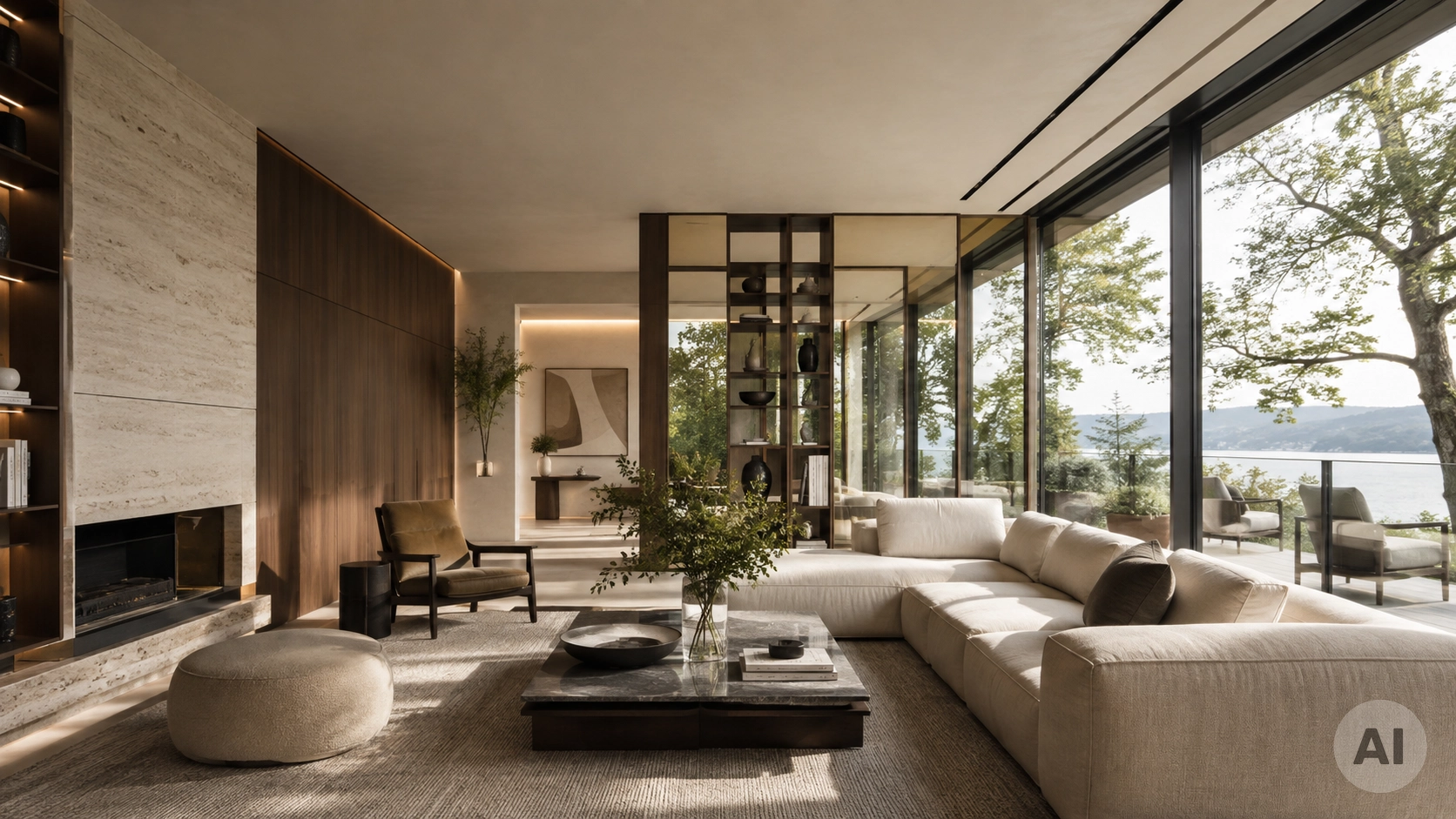
For us, this also includes the relationship with outdoor areas. Terraces, gardens, balconies or a distinctive view should not be treated as mere additions. When interior and exterior spaces are connected through sightlines, materials and openings, the existing architecture can be perceived as significantly more spacious.
Lighting Design Influences the Perception of a Property
Light is one of the most effective tools in interior design. Natural daylight should penetrate as deeply as possible into the rooms and enhance the existing architectural qualities. Artificial lighting, meanwhile, should do more than simply provide sufficient brightness; it should support different uses and atmospheres.
High-quality lighting design therefore works on several levels. General lighting provides orientation, functional lighting supports specific activities, and carefully positioned accent lighting highlights materials, art, built-in elements or architectural features. In this way, light itself becomes an integral part of the architecture.
Particularly in properties in the premium segment, this difference is immediately noticeable. Precise lighting design can make rooms appear calmer, deeper and more refined without overloading the architecture with additional decorative elements.
Materiality: Longevity Instead of Short-Term Trends
High-quality materials convey quality not only visually. Natural stone, wood, metal, glass, textiles and mineral surfaces possess tactile qualities, distinctive ageing characteristics and their own spatial presence. What matters, however, is less the number of exclusive materials used than their consistent selection and workmanship.
For properties with a long-term investment horizon, material concepts that are not tied to short-lived trends are preferable. Good materials are allowed to age. Wood develops a patina, natural stone has individual structures, and carefully executed surfaces retain their aesthetic quality for many years.
This approach is also becoming increasingly important from a sustainability perspective. Longevity, repairability and the responsible use of resources are becoming essential criteria for future-proof design. An interior that does not need to be completely replaced after just a few years combines enduring design quality with a responsible approach to materials.
Storage as an Underestimated Value Factor
Storage is one of those aspects whose importance often only becomes apparent in everyday use. Particularly in urban apartments, available space is valuable. Freestanding wardrobes and storage solutions added at a later stage can visually reduce the size of rooms and compromise the original architecture.
Integrated storage, by contrast, makes use of wall surfaces, niches and transitional areas. Wardrobes, libraries, kitchens, dressing rooms or full-height cabinetry can be planned as part of the architecture. Technology, household functions and personal belongings disappear where they do not need to remain visible.
The result is not simply greater organisation. Rooms appear calmer, more spacious and clearer. For future buyers or tenants, this creates an immediately recognisable functional benefit.
High-Quality Built-Ins Create Identity
For us, bespoke built-in elements are among the most effective tools of interior design conceived for the long term. Unlike interchangeable furniture, they respond precisely to the architecture, proportions and use of a property.
A custom-designed kitchen, library, integrated media wall or precisely executed dressing room can become a natural part of the property itself. This is where the importance of craftsmanship becomes particularly evident. Good details do not need to be conspicuous. Precise joints, high-quality fittings, carefully considered connections and expertly finished materials create the sense of effortless quality that distinguishes sophisticated interiors.
Not Every Expensive Renovation Automatically Creates Added Value
For investors, this distinction is crucial. A higher budget does not automatically result in a better property. If capital is invested primarily in short-term trends, decorative surfaces or fittings that do not suit the location and target group, a renovation can fail to meet the actual demands of the market.
The Swiss property market illustrates this challenge particularly clearly. Many renovated properties in urban regions are positioned in the upper price segment. At the same time, this increases competition within that segment. Quality must therefore be understood in a more differentiated way: not as the most expensive possible specification, but as the precise coordination of architecture, functionality, materials and target group.
For asset managers and owners, this means prioritising investments according to their actual impact. Floor plan and usability come before decorative measures. Good lighting design comes before spectacular light fixtures. Durable materials come before short-lived trends. And intelligent built-in solutions can provide greater long-term value than interchangeable furnishings.
Existing Properties Are Becoming Increasingly Important in Switzerland
These considerations are becoming particularly relevant in Switzerland. Given limited available space, high construction costs and a demanding property market, attention is increasingly shifting towards the existing building stock. Renovation, conversion and repositioning are therefore becoming central tasks in property development.
In the Zurich region in particular, high property values coincide with demanding users and a limited market for high-quality properties. Positioning a property solely through luxurious fittings therefore falls short. What matters is the quality of the overall concept and whether a property can continue to meet different requirements over the long term.
Future-Proof Interior Design Requires Flexibility
Living and working models are changing. Rooms used as home offices today may become guest rooms, libraries or private retreats tomorrow. Family structures evolve, as do requirements for working from home, privacy and communal areas.
Good interior design takes these changes into account without attempting to predetermine every possible future scenario. Flexible floor plans, neutral architectural structures, sufficient storage and durable materials create the foundation for properties to remain attractive throughout different phases of use.
Increasing Value Begins with the Quality of the Space
Interior design can neither compensate for an unsuitable location nor guarantee a specific return on investment. It can, however, reveal the existing qualities of a property, reduce functional shortcomings and significantly improve usability.
For private and institutional investors, owners and asset managers, this is precisely where its strategic value lies. Successful interior design combines economic considerations with enduring design quality. Spatial impact, lighting, materiality, storage and high-quality built-ins are not considered in isolation, but as an interconnected system.
At Anlela Design in Zurich, we therefore understand interior design as a long-term investment in the quality of a property. Our aim is not to make spaces appear spectacular for a brief moment. We develop interiors whose architecture, functionality and materiality continue to feel natural and coherent for years to come – creating a quality that endures far beyond the first impression.