
Swiss interior design possesses a distinctive strength: it does not need to be loud to convey a sense of origin and quality. Materials such as Swiss pine, natural stone and lime plaster, together with traditional techniques such as Engadin sgraffito, tell stories of landscape, craftsmanship and cultural identity. Used in a contemporary way, they do not create nostalgic settings, but calm, sophisticated spaces with a clear connection to their location.
At Anlela Design, we do not regard regional design as a decorative theme. An interior does not automatically become Swiss simply through the use of visible timber, rough stone or Alpine motifs. What matters is how materials are selected, proportioned and crafted, and how they are integrated into modern architecture. Authenticity does not arise from copying historic styles, but from developing them with precision.
Swiss identity without chalet clichés
The traditional chalet has become an international symbol of Swiss living culture. At the same time, the style is often reduced to rustic timber walls, heavy furniture, checked fabrics and conspicuous mountain motifs. This type of staging can quickly appear generic and does little justice to the true diversity of Swiss architectural culture.
Switzerland is not defined by the chalet alone. Engadin houses, Ticino stone houses, stately villas, rural farmhouses and clearly structured modernist buildings each possess their own materials, proportions and craft traditions. For contemporary interior design, it is therefore worth taking a closer look at the specific location. Which materials characterise the surroundings? How does natural light enter the building? Which colours can be found in the landscape, the architecture and the existing structure?
A credible design does not reproduce these characteristics literally. It translates them into a modern visual language. Instead of carved decoration, clean geometric milling can be used. Instead of fully panelling an entire room, a precisely crafted wall surface made from Swiss pine may be sufficient. Rather than installing a massive stone fireplace, a monolithic natural-stone structure can form a calm focal point within the room.
Sgraffito as inspiration for modern interiors
Sgraffito is one of the characteristic decorative techniques of the Engadin region. Ornaments and motifs are scratched into layers of plaster while they are still moist. On historic façades, they frame windows, doors and building edges, tell stories of families, symbols and local traditions, and continue to shape the appearance of many villages in the canton of Graubünden.
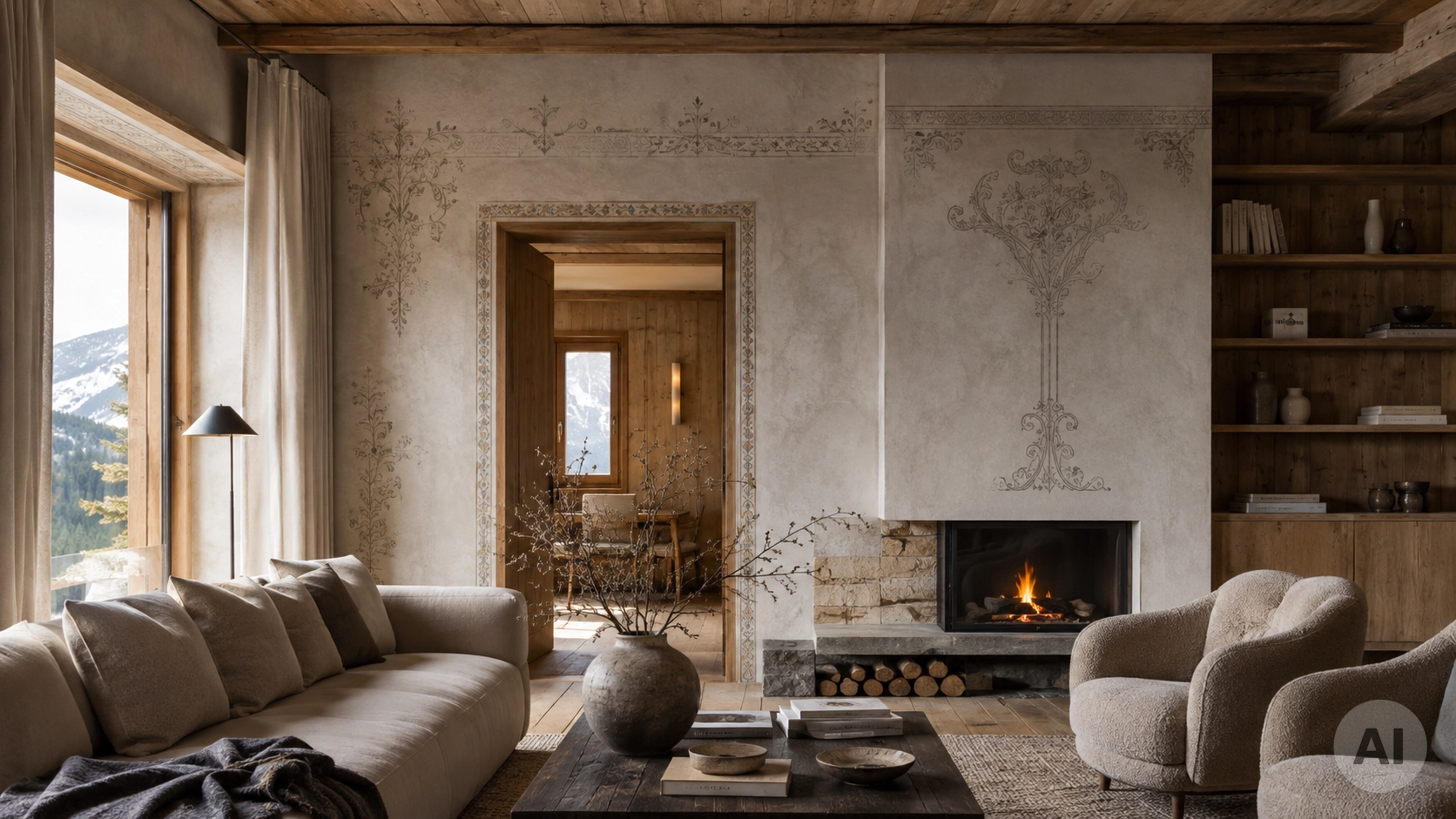
For modern interior design, the most interesting aspect is not the direct reproduction of historic ornaments, but the principle behind the technique: depth is created through the removal of material and the interplay of light and shadow. This principle can be transferred to walls, furniture, doors or room dividers. A restrained incised pattern in lime plaster can subtly structure a wall. Milled cabinet fronts can abstract traditional geometries. Textile surfaces, metalwork and plaster reliefs also provide opportunities to reinterpret the graphic language of sgraffito in a contemporary way.
Restraint is essential if the result is to remain elegant. A single, precisely positioned motif has a stronger effect than decoration covering an entire surface. Tradition therefore becomes not a stage set, but a subtle cultural layer that reveals itself only on closer inspection.
Swiss pine between Alpine tradition and modern luxury
Swiss pine is closely associated with the Alpine region. Its lively knots, warm colouring and distinctive fragrance make it a special material for furniture, wall panelling and bespoke fitted elements. In traditional living rooms, Swiss pine was often used extensively. In modern interiors, it is particularly effective when applied selectively and combined with calm, understated materials.
A floor-to-ceiling library, fitted wardrobe or wall covering made from Swiss pine can bring warmth to a clearly designed room without making it appear rustic. The details are decisive: narrow joints, flush-fitting doors, understated handles and the careful selection of individual timber sections. The more precise the craftsmanship, the more contemporary the material appears.
Compelling contrasts can be created by combining Swiss pine with mineral plaster, brushed metal, glass or dark natural stone. High-quality textiles can further enhance the sensory qualities of the wood. Linen, wool and fine bouclé fabrics complement its natural texture without competing with the grain.
Swiss natural stone as an architectural element
Natural stone creates an immediate connection between interior spaces and the surrounding landscape. Its colour, texture and mineral depth give rooms a sense of permanence. Depending on the region, Switzerland offers a wide variety of stone types and architectural traditions. Particularly in Alpine areas, stone is not merely a decorative material, but has been an integral part of the building culture for centuries.
In high-quality interiors, natural stone should not be treated as a surface pattern selected as an afterthought. Its effect is strongest when it performs a clear architectural function: as flooring, a fireplace, a kitchen island, a washbasin, a staircase or a bespoke piece of furniture. Generous slab dimensions and carefully planned joints allow the material to appear calm and natural.
The choice of finish is particularly important. Polished stone reflects light and creates a prestigious appearance, but can quickly seem overly formal in an Alpine setting. Honed, brushed or finely textured surfaces are more understated and allow the natural markings of the stone to emerge more clearly. The decision should always be coordinated with the intended use, the lighting conditions and the desired atmosphere of the room.
Regional craftsmanship as true luxury
Luxury is not defined solely by the price of a material. It is expressed through the quality of its craftsmanship. A hand-applied plaster surface, precisely fitted joinery or an individually developed metal structure possesses a depth that industrially manufactured standard solutions can rarely achieve.
Collaboration with specialised craftspeople makes it possible to process materials specifically for each project. Timber can be sorted according to its grain, stone can be cut in line with the direction of its veining, and metal can be finished to achieve the desired degree of sheen. In the completed interior, such decisions are not always immediately obvious or easy to explain, but their effect can be felt instantly. They create calmness, quality and durability.
This individual planning is especially important for exclusive villas, holiday residences and apartments. The aim should not be to create an interior that follows a short-lived trend. It should be to design a space whose materials age gracefully and gain character over time.
How regional materials can appear modern
For traditional materials to feel contemporary, they require clear proportions and a controlled material palette. Too many regional references within a single room can quickly make the design appear overly thematic. It is often sufficient to use two or three materials consistently and to execute their transitions with precision.
A mineral floor, for example, can be complemented by fitted elements made from Swiss pine, while a single wall featuring an abstract sgraffito relief introduces a cultural accent. Natural stone can begin inside the building and continue onto a terrace. In this way, it connects architecture, interior design and landscape. Regional identity arises from the interaction between the materials rather than from visible symbols.
Colour also plays a central role. Muted shades of grey, sand, green and brown reflect the Swiss landscape without depicting it literally. Individual dark elements can create depth, while warm textiles and timber surfaces soften the strict lines of the architecture.
Interior design with a sense of origin and a vision for the future
A modern Swiss interior does not have to choose between tradition and the present. The strongest spaces combine both. They respect historic techniques and regional materials without becoming nostalgic. They are clearly designed, expertly crafted and firmly connected to their location.
At Anlela Design, we develop interiors from the architecture, the landscape and the individual way of life of their occupants. We regard sgraffito, Swiss pine and natural stone not merely as stylistic devices, but as potential carriers of identity. Through careful selection, contemporary proportions and collaboration with experienced craftspeople, we create spaces that feel unmistakably Swiss without needing to explain themselves.
The result is a form of quiet luxury: authentic, precise and enduring. Interior design that does not seek short-term attention, but instead focuses on atmosphere, quality and a profound connection between people, space and landscape.