
A room with history possesses something that cannot simply be recreated: proportions shaped over time, traces of past use, craftsmanship details and an atmosphere that has developed over decades or even centuries. In Zurich in particular, these qualities meet high expectations for contemporary living. At Anlela Design, we do not see this as a contradiction. Quite the opposite: the most compelling interiors often emerge where historic architecture is not preserved like a museum piece, but thoughtfully reinterpreted with respect. Modern Heritage describes precisely this approach – combining existing architecture with the present to create spaces that feel neither nostalgic nor short-lived.
What Modern Heritage means in interior design
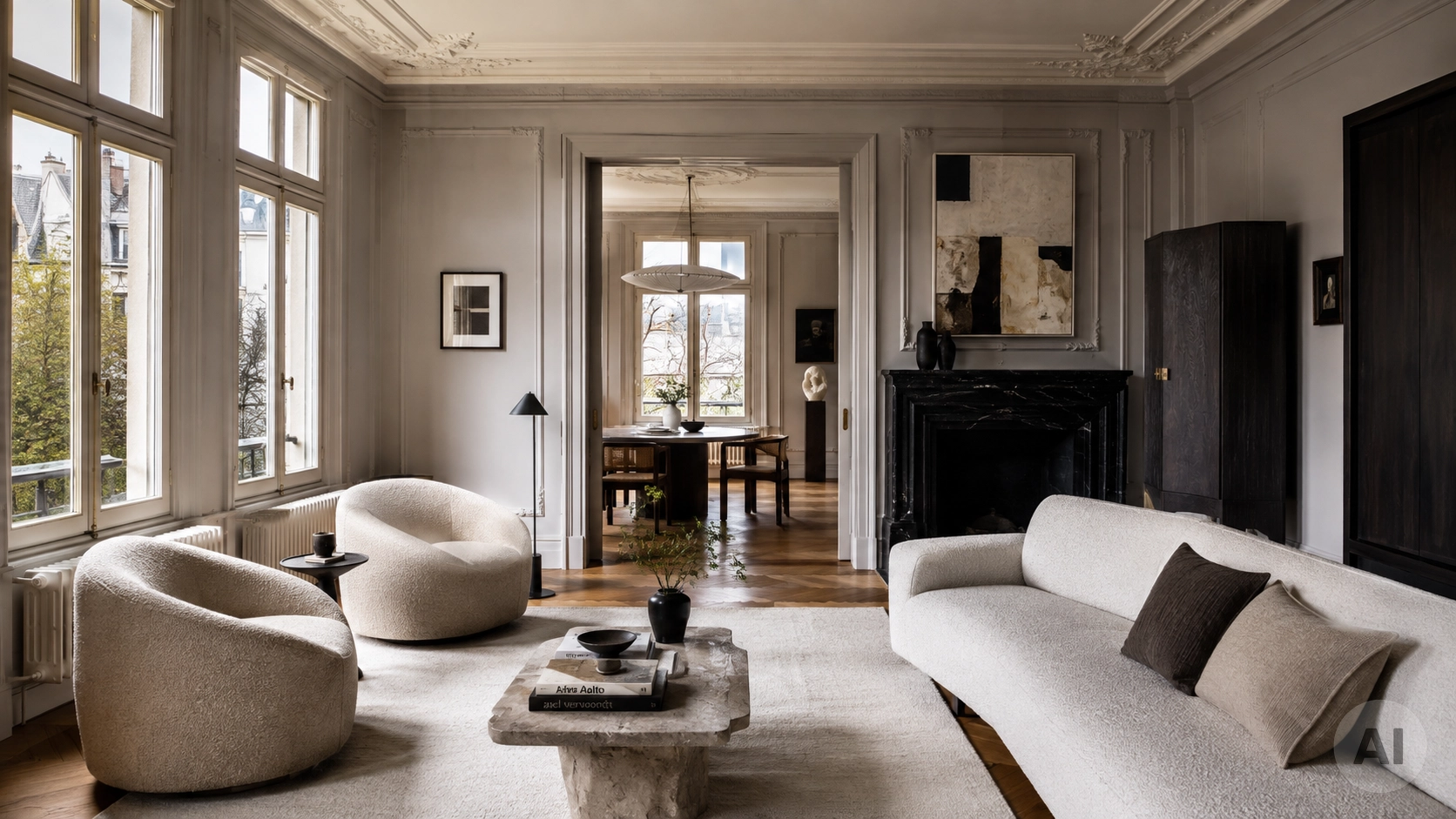
Modern Heritage is neither a historic interior style nor a return to the living environments of the past. What matters instead is the dialogue between different eras. Existing wood panelling, parquet flooring, stucco, natural stone, old doors or distinctive windows can meet clean-lined built-ins, contemporary art, modern lighting and carefully selected designer furniture. It is precisely this contrast that creates tension and interest. A historic room does not lose its identity; rather, it gains a new dimension. The art lies in neither removing every trace of age nor treating every historic element as an untouchable museum piece. Good interior design recognises which elements define the character of a building and which areas can be transformed.
Zurich as a setting for the dialogue between old and new
Zurich provides a particularly interesting architectural context for this approach. Gründerzeit townhouses, villas on the Zürichberg and around the lake, buildings of classical modernism and post-war architecture form an exceptionally diverse architectural heritage. At the same time, expectations regarding comfort, technology and functionality continue to evolve. A contemporary home requires different kitchens, bathrooms, lighting concepts, storage solutions and technical infrastructure than those available when many of these buildings were originally constructed. The aim is therefore not to return a house to an earlier state. Rather, it is about understanding its architectural language and deriving a credible next stage of development from it.
Reading the existing architecture first
When working with existing architecture, our design process does not begin with a mood board, but with observation. Which proportions define the room? Where does daylight enter? Which sightlines already exist? Which materials possess a quality worth preserving? And which elements added later disrupt the original clarity? Particularly in high-end renovations, restraint can be more effective than a complete design reset. An old wooden floor with visible patina, for example, can possess more depth than a flawless new surface. A solid door or a natural stone element can become the starting point for an entire material concept. What matters is the hierarchy: the existing architecture sets the tone, and new elements respond to it.
Materials connect past and present
Materiality plays a central role in Modern Heritage. Wood, natural stone, metal, lime plaster, glass, leather and high-quality textiles age differently and therefore create a natural sense of depth. We prefer materials whose character does not depend solely on being new. Oiled wood may darken over the years, brass or bronze can develop a patina, and natural stone should be allowed to reveal its individual veining. These are precisely the qualities that make premium materials interesting in the long term. The result is an interior that does not feel sterile, but instead gains personality over time.
Bespoke built-ins as a subtle connection
Bespoke built-ins are particularly important. In historic floor plans, standardised solutions often work only to a limited extent. Wall lines, ceiling heights, niches and window axes require individual responses. A precisely designed fitted cabinet can accommodate modern functions while integrating naturally into the architecture. Kitchens can be conceived as part of the room rather than appearing as technically dominant foreign elements. Media equipment, building technology and storage can largely disappear from view. For us, luxury here does not come from displaying as many functions as possible, but from clarity. Technology should enhance comfort without determining how the room is perceived.
Design classics and contemporary furniture in the same room
Modern Heritage does not end with architecture. Furnishing also thrives on the deliberate interplay of different eras. A 20th-century design classic can stand alongside a contemporary piece, while a handcrafted one-off can share a space with a rigorously modern sculpture. What matters less than the year of production is the quality of proportion, material and concept. Well-chosen furniture pieces do not compete with one another; they create a layered composition. In historic interiors especially, this combination prevents the space from feeling like a reconstruction.
Why contrasts make spaces more authentic
For us, the most common mistake when renovating historic interiors is attempting to make everything stylistically uniform. If every new surface is artificially aged and every new piece of furniture is designed to look historic, the result can quickly feel like a stage set. Conversely, radical modernisation can erase the spatial identity entirely. Visible contrasts are more convincing. A minimalist light fixture can look unmistakably contemporary beside a historic stucco ceiling. A new steel staircase does not need to pretend that it is a hundred years old. A precisely cut block of natural stone can deliberately contrast with an existing timber structure. It is precisely these opposites that give a room depth and authenticity.
Light determines how existing architecture is perceived
Historic architecture was often designed for a different relationship between daylight and artificial lighting than today’s interiors. Lighting design therefore requires particular sensitivity in a Modern Heritage concept. Rather than illuminating rooms uniformly, we work with different layers of light. Indirect lighting can model historic surfaces, directional lighting can highlight art, and decorative luminaires can deliberately appear as contemporary objects. At the same time, existing daylight should be allowed to flow as freely as possible. Especially in villas and apartments overlooking the Zurich landscape or the lake, the relationship with the outdoors is an essential part of the spatial experience. Windows are then understood not simply as openings, but as framed views.
Interior and exterior as part of the same story
In many historic houses, the connection to the landscape is already embedded in the original architecture. Terraces, verandas, loggias, large window axes and garden spaces define how interior and exterior communicate with one another. In a contemporary reinterpretation, this potential should not be lost through an isolated approach to interior design. We therefore consider architecture, interiors and the relationship with the outdoors as one cohesive composition wherever possible. Materials can visually continue from inside to outside, colour palettes can respond to the surroundings, and furniture can be positioned to preserve important sightlines. In this way, nature is not brought into the room merely as decoration, but used as an inherent quality of the architecture.
Art creates a bridge between eras
Art can play a particularly powerful role in a Modern Heritage concept. Contemporary works can transform the perception of historic interiors without altering their fabric. A large-scale abstract work against a classical wall, a sculpture positioned along an old spatial axis or photography placed beside traditional woodwork can create deliberate friction. This tension prevents an interior from feeling like a reconstruction. At the same time, it introduces a personal dimension. After all, a high-quality home should not merely be architecturally correct; it should also reflect the interests, memories and personality of its residents.
Preservation is also a form of sustainability
Beyond its aesthetic qualities, Modern Heritage also represents a fundamental principle: existing fabric is treated as a resource. Not every component needs to be replaced simply because it is old. High-quality materials, skilled craftsmanship and robust construction can remain functional for generations when properly maintained and thoughtfully developed. This does not mean ignoring energy efficiency or technical requirements. Instead, new solutions must be integrated precisely into the existing structure. Intelligent reuse not only preserves architectural identity, but also avoids unnecessary material consumption.
Modern Heritage as an alternative to short-lived interior trends
For us, the true strength of Modern Heritage lies in the fact that this approach does not depend on any single trend. Spaces derive their quality from architecture, materials, craftsmanship, art and personal objects. They are allowed to evolve and do not need to be completely redesigned after just a few years. This philosophy is particularly well suited to high-end properties whose architecture itself possesses lasting value. A carefully renovated house should not look like a relic of a particular interior trend ten or twenty years from now. It should be able to age naturally and gracefully.
Our approach at Anlela Design
At Anlela Design, we do not see historic architecture as a limitation, but as a starting point. We seek to understand the character of a building and use it to develop a contemporary interior design that strengthens that character. This includes clear spatial structures, bespoke built-ins, carefully curated furniture, natural materials, precise lighting design and a deliberate dialogue with art and landscape. Particularly in Zurich and Switzerland, where high-quality architecture, craftsmanship and a strong building culture come together, we see enormous potential in this approach. For us, Modern Heritage does not mean reproducing the past. It means taking it seriously – and using it to create spaces that will continue to endure in the future.